 Recherche dans les forums

Résultat de votre recherche : 242 résultats

Re: DiNoël 2021
Posté par Webmaster, dans Bavardage,
le
 6 584
6 584
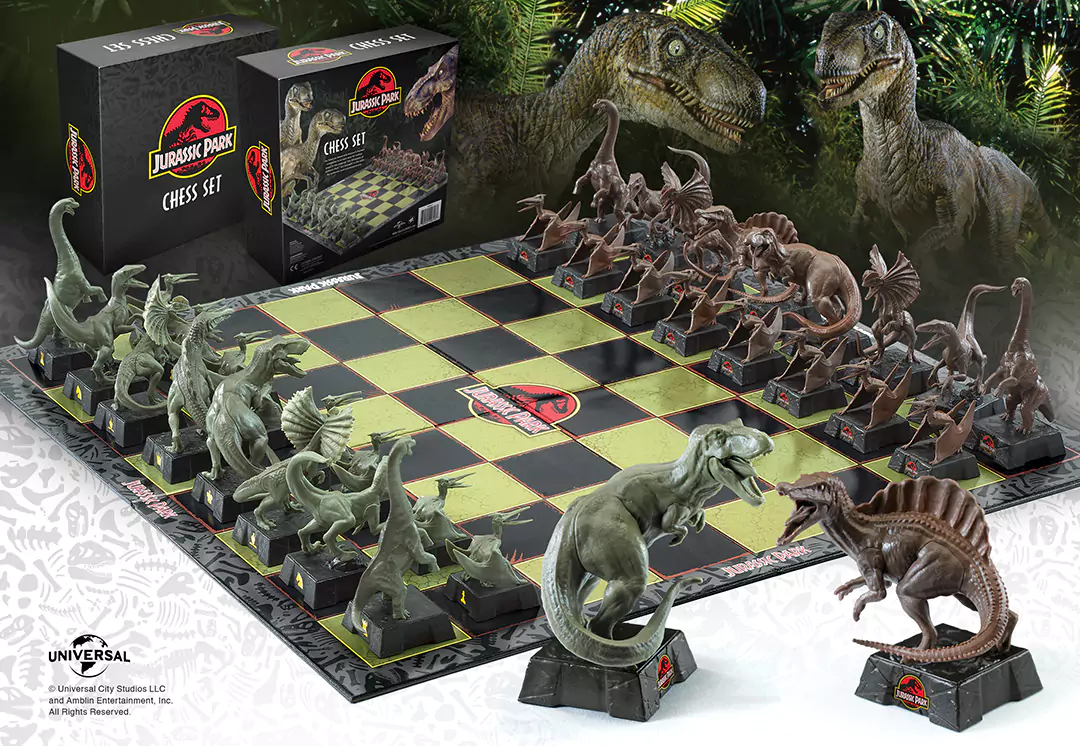
Les figurines ont l'air d'être très bien faites.
Le roi est le T.rex, la reine le Spino, les fous sont des Dilophosaures, les chevaliers des Vélociraptors, les tours sont des Brachiosaures et les pions des Ptéranodons... ça donne envie d'y jouer.
Par contre, c'est une soixantaine d'euros, chez Noble, parmi d'autres licences (Harry Potter, Game of Thrones, etc.).
Re: Jurassic World Evolution 2
Posté par Tyrannosaurus rex, dans Jurassic Park,
le
15 319
Source: Jurassic-Park.fr
----------
Edité le 22/06/2021 à 13:29 par Tyrannosaurus rex
Re: Camp Cretaceous ! Alors ? Qu'en avez-vous penser ?
Posté par Tyrannosaurus rex, dans Jurassic Park,
le
12 943
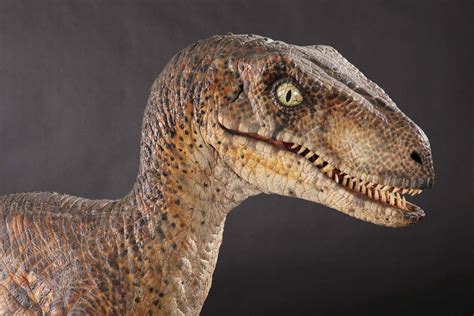
Et j’ai aussi remarqué un clin d'œil à JP1.
Regarder bien cette pose de toro, ça vous rappelle rien ?
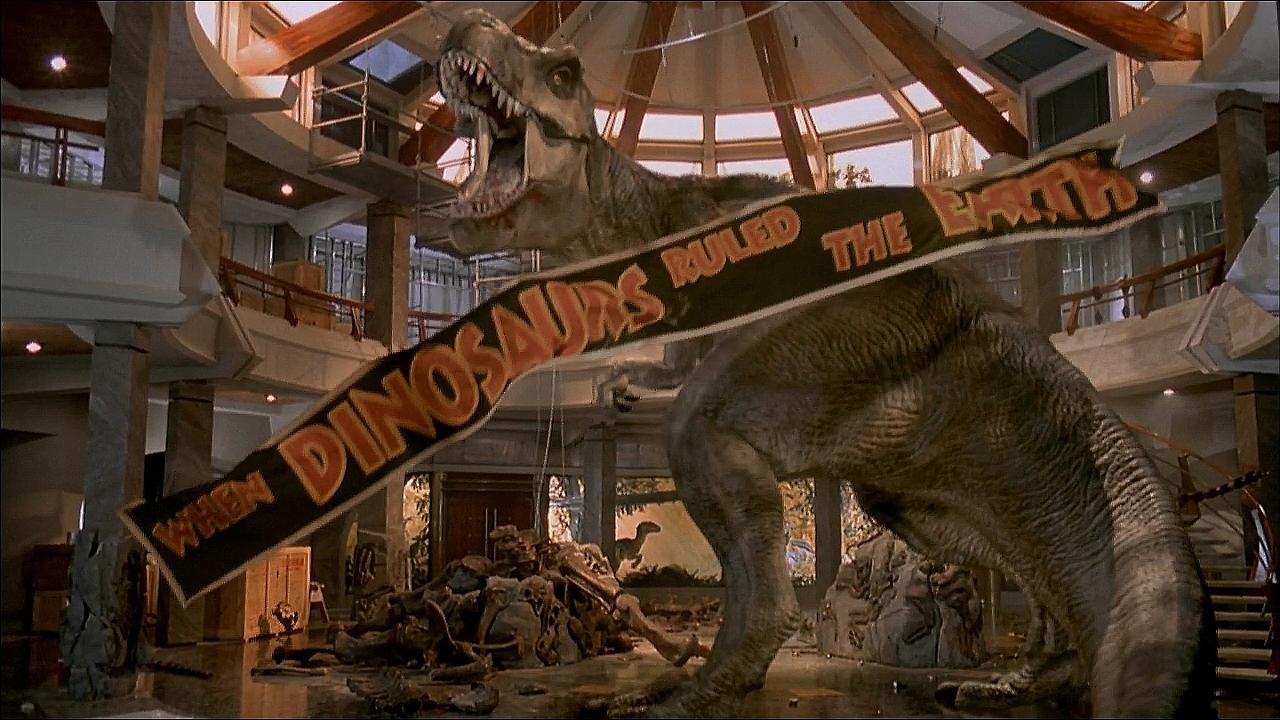
Eh oui, ils s’en sont inspirés !!!
----------
Edité le 12/10/2020 à 22:34 par Tyrannosaurus rex
Re: Camp Cretaceous ! Alors ? Qu'en avez-vous penser ?
Posté par Quent, dans Jurassic Park,
le
12 880
Re: Jurassic World Évolution
Posté par Tyrannosaurus rex, dans Jurassic Park,
le
12 766
Celui de JP3

Re: Jurassic World Évolution
Posté par Tyrannosaurus rex, dans Jurassic Park,
le
12 780
Et j'ai vu le Pteranodon. Mais il s'agit du même Pteranodon.
Alors, point positif :
-j'adore ses couleurs, même si celles de JP3.
Maintenant, point négatif (
 Attention, c'est salé, vous êtes prévenus ) :
IL A DES PU***NS DE DENTS DANS SON BEC.
PTÉRANODON SIGNIFIE "AILE SANS DENTS" BO***L DE ME**E





Re: Jurassic World Évolution
Posté par Tyrannosaurus rex, dans Jurassic Park,
le
13 912

Le centre des visiteurs.

Le Tyrannosaurus rex guettant un Parasaurolophus

Un Stegosaurus

Un "Velociraptor"

Deux Parasaurolophus

Un Brachiosaurus (sans doute celui de JP1)

Une Jeep en train de contempler le Brachiosaurus

Et enfin, une volière avec un Pteranodon
Re: Idées reçues sur les dinosaures et les fossiles
Posté par Tyrannosaurus rex, dans Archives des forums,
le
8 665
J'ai vu aussi ,dans les bonus de JP3, qu'il saurait le décendant de Pteranodon longiceps.
Lorsque j'ai vu ça, j'avais l'air d'halluciné, les yeux grand ouvert et bouche-bé
Bon, en même temps, c'était l'animateur des effets visuels, et non Jack Horner, non parce que là, ce serait la honte de la part d'un paléontologue de renommée mondiale.
Mais en même temps, je ne suis pas sûr qu'il s'est renseigné ou si Horner lui à dît mais que l'animateur des effets visuels ait vite oublié ou n'en n'a fait qu'a ça sa tête
.----------
Edité le 27/02/2019 à 11:49 par Tyrannosaurus rex
----------
Edité le 08/09/2019 à 19:07 par Tyrannosaurus rex
----------
Edité le 04/10/2019 à 11:27 par Tyrannosaurus rex
----------
Edité le 16/11/2019 à 17:24 par Tyrannosaurus rex
Re: œuf de Ptérosaures ?
Posté par Gigy, dans Autres fossiles,
le
12 818
Ah comme ça tu aimes les dinosaures à plumes, normal.
Plus sérieusement, même si on a pas de comportement fossile il est possible d'inférer quelques éléments de réponse du fait de l'étude de l'encéphale. Le télencéphale est bien développé ce qui signifie que leurs capacités devaient certainement plus importantes que ce que l'on a longtemps cru.
Se toiletter? Pourquoi pas, on a des exemples qui montrent que certains ptéro avaient apparemment tendance à se regrouper alors de là à imaginer des relations sociales développées c'est parfaitement plausible.
Attention que à la fin du crétacé on a deux type de ptéro qui restent.
Les Pteranodontidae ont disparus mais une branche latérale des ornithocheiroidea a continué, les nyctosauridae, les ptérosaures les plus dérivés à avoir jamais existé. Tellement aériens que la longeur de leur membres antérieurs leur permettaient à peine de se tenir sur le sol. Les doigt quarte est réduit à 3 phalanges au lieu des 4 réglementaires. De plus les 3 doigts qui forment la main ont eux aussi disparus.
Ces animaux ne sont pas des géants puisque leur envergure ne dépasse pas les 1,50 m.
Ceux dont tu parles sont les azdharchidae géants de la fin du Maastrichtien. Ces animaux là ont atteint 10,5 m d'envergure pour un poids de 250 kilos.
Re: question sur la disparition des ptérosaures
Posté par Gigy, dans Débutants,
le
7 631
Si certaines familles s'éteignent (comme les boreopteridae) d'autres famille ou groupes entiers, continuent (ornithocheiridae, Ctenochasmatoidea et les azhdarchoidea) Mais plus tard au Campanien il ne reste plus que trois familles!
Les Pteranodontidae, les Nyctosauridae et les neoazdharchidae. Les pteranodontidae vont s'éteindre avant le dernier étage, Si bien que à la toute fin il ne reste plus que les neoazhdarchidae (Quetzalcoatlus, Arrambourgianna et Hatzegopteryx) des animaux gigantesques, hyperspécialisés et peu nombreux en terme de genre et d'espèces et les Nyctosauridae, les ornithocheiroidea les plus dérivés (absence de doigts de marche et trois phalanges au doigt IV au lieu de 4). Face à cette hyperspécialisation l'issue était si pas prévisible tout de même envisageable.
On constate que les oiseaux vrais, prennent petit à petit l'ascendant sur les ptérosaures qui se réfugient dans des niches écologiques spécialisées (espèces hyperadaptées au vol au point de ne presque plus descendre à terre, pour les Nyctosauridae chez lesquels les proportions des membres sont hallucinantes tellement les membres antérieurs sont démesurés et les neoazdharchidae qui atteignent des tailles gigantesques.
Rappel des tailles gargantuesques de ces géants des airs!
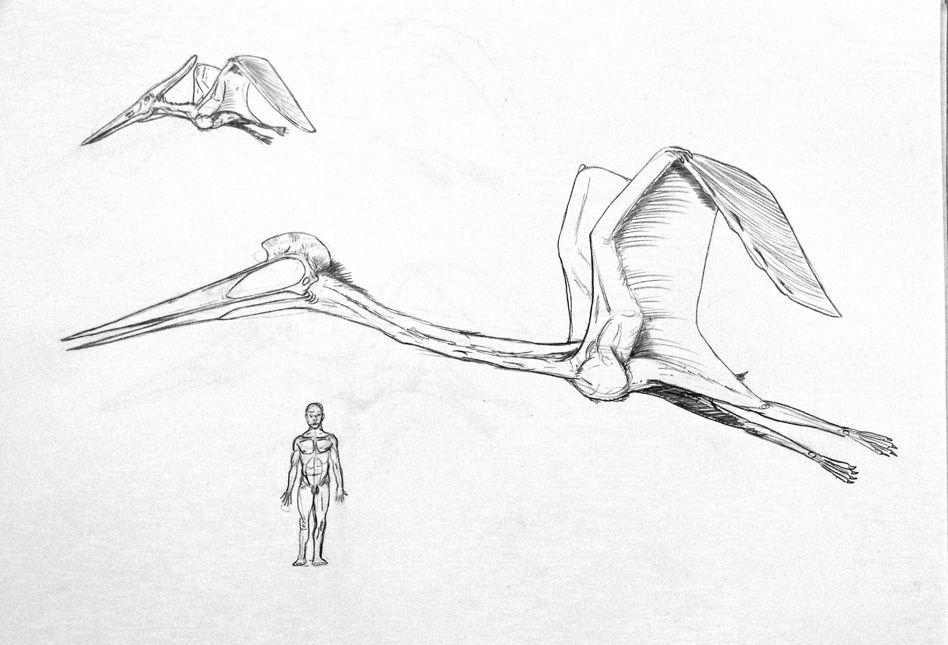
Le crâne du Pteranodon longiceps mâle au dessus est de 1,60 m, le Hatzegopteryx figuré en bas à lui un crâne de 3 mètres de long! reconstitution proposée sur base de comparaisons avec Quetzalcoatlus et Zheniuanopterus.
----------
Edité le 29/03/2014 à 00:10 par gigy
Re: il est sorti!
Posté par Gigy, dans Publications paléontologiques…,
le
25 376
Il complète a merveille LA bible de Peter Welnhoffer qui restera LA référence malgré qu'il est un peu dépassé aujourd'hui.
J'attends aussi le PTEROSAURIA qui lui promet d'être dantesque! 800 pages! 5 années de retard c'est dire si ils prennent leur temps.
Voici ce que witton dit de Deep time:
Many, many moons ago, the Heroes of Pterosaur.Net were suggested to provide a reading list for people who just can't get enough of our leathery-winged chums. Longer-term Pterosaur.Net groupies with good memories may recall that our suggested shortlist was, well, very short with only two notable tomes: Peter Wellnhofer's 1991 Illustrated Encyclopaedia of Pterosaurs and David Unwin's The Pterosaurs from Deep Time (2005). You were promised reviews of both: we looked at the Encyclopaedia back in January (seriously, where is 2010 going?) and, today, we're casting our critical eyes over The Pterosaurs from Deep Time. If it sounds like the pterosaur book for you, however, you're going to have to go Sherlock to find it: it's been discontinued for a number of years and only loiters now in second-hand stores. However, Mike from Ottawa informed us last time that he found a cheap copy in an online store that only set him back $10, so you may not have to pay through the nose to obtain one. Question is, of course, do you want to own it in the first place?
The best pterosaur book since the last one
Believe it or not, there have only ever been three popular English books on pterosaurs published: Harry Seeley's Dragons of the Air (1901 – yes, 1901), Wellnhofer's Encyclopaedia, and the organ under our spotlight today, The Pterosaurs from Deep Time. The former books set a high benchmark for treatment of their subject matter: Seeley's book is a classic, a slice of pterosaur history that summarises Seeley's heretical ideas on pterosaur origins, biology and ecology. Seriously diehard pterosaur aficionados will want a copy but, alas, unless you find a lucky copy in a second hand shop, you'll have to fork out a lot for it (cheapskates like me, though, can download the entire thing, for free, from here). Wellnhofer's effort, as discussed previously, remains an essential reference tool for anyone with an interest in flying reptiles and has aged with dignity over the last 20 years. In fact, the only thing that Wellnhofer got wrong with his book was his timing: it was published just before the recent pterosaur research bonanza started (fuelled by spiffing new specimens from Brazil and China) and, therefore, doesn't report the cohesion of ideas that he may have if he wrote it in 2000, say.
So, when Dave Unwin entered this arena with his book in 2005, he wasn't exactly swamped with competition. With his main contenders being a dusty, ultra-rare historical tome and an excellent but rather old-fashioned encyclopaedia, he could've produced a sloppy, poorly-illustrated mess and still stood a chance of writing the best modern pterosaur book. Thankfully for us, The Pterosaurs from Deep Time continues the trend of its predecessors and is an excellent, informative presentation of modern ideas in pterosaur research. Given the prestige of its author, this isn't a huge surprise: David Unwin is widely recognised as one of the foremost pterosaur experts in the world. Beginning his career with an assessment of the Victorian taxonomic mess that is the Cambridge Greensand pterosaur assemblage, Unwin has since worked on pterosaurs from all over the world and made significant contributions to research on virtually all aspects of their palaeobiology (including [deep breath]: pterosaur phylogeny, several geographical and taxonomic reviews, details of their flight apparatus, pterosaur respiration, reproduction, terrestrial locomotion and, most recently, bringing the world Darwinopterus). Given that his writing style is also extremely breezy and clear, he's surely one of the most suitable pterosaur palaeontologists around to summarise the current status of pterosaur knowledge. Hence, saying Unwin's book is ‘the best since the last one' is not only true by default, but also a considerable complement in saying that Deep Time is a worthy follow-on to Wellnhofer's Encyclopaedia.
The pterosaur story
Although comparisons between Deep Time and the Encyclopaedia are inevitable, they're not entirely fair because the two books have very different formats. The Encyclopaedia is quite schematic in its layout with clearly defined sections and liberal use of detailed, technical diagrams: it feels far more like a textbook than something you would read from cover to cover. Deep Time, by contrast, is far more prosaic, flowing from chapter to chapter in a continuous way that makes it very easy to read in entirety. It begins with an introduction to pterosaurs and the concepts of fossilisation and geological time before moving onto an overview of pterosaur phylogeny (based on Unwin's 2003 work), their anatomy, locomotion, reproduction and, finally, an attempt to tell the complete tale of pterosaur evolution. The encompassing approach of this latter chapter is very characteristic of Unwin's work: many of his technical publication feature discussions of the broader implications for whichever topic is under scrutiny, be it eggshells (Unwin and Deeming 2008) or wing membrane distribution and terrestrial locomotion (Unwin 1999). The story presented in the penultimate chapter of Deep Time seeks to tie all the threads from the prior chapters together, explaining how and why pterosaurs took to the skies, the rise and success of pterodactyloids and their eventual extinction. Beyond this lies a wealth of footnotes and references to keep technical pterosaur buffs happy, along with a list of valid pterosaur species. As may be expected, the information was, at the time of writing, entirely up-to-date and we're given the full benefit of the first 15 pterosaur bonanza years, including pterosaur brain CT scans to the wealth of soft-tissue data revealed by Brazilian and Chinese fossil Lagerstätten. There is, therefore, a wealth of information and interpretation held in Deep Time and, thanks to Unwin's frequent quips and asides, it's as enjoyable to read as it is informative.
We're treated to glossy, full-colour illustrations for much of the book and, while the sources of many images will be known to those familiar with other pterosaur literature, most diagrams and drawings are well-executed and tie in nicely with the text. The excellent photographs, many of which are of previously unpublished details of well-known specimens or entirely new finds, are worthy of mention as are the superb pterosaur paintings by Todd Marshall that are dotted throughout the book (see image, above, of a Marshall Quetzalcoatlus, along with the Sordes on the book cover at the top of this post). I have a soft-spot for Marshall's work: his animals and environments look refreshingly imperfect, a bit like they've been left outside in the wind and rain for some time. Plus, his style is one of the most striking and recognisable among the modern crop of palaeoartists. His punky, scruffy pterosaurs are no exception, and the depth he gives to his environments creates the impression of a broader world beyond the confines of the canvas. Happily, his pterosaur anatomy and postures aren't too bad either, making his images a handy source of modern pterosaur restorations.
But…
So it's praise, praise, praise, for Deep Time, then, but it's not all good. For one thing, while most of the figures are absolutely spiffing, a few are a bit shaky with ugly, blocky lines, flat colours and poorly-defined details. This never becomes so much of a problem that you cannot see what the figure represents and there are only a handful of instances in the entire book, but the difference in quality between some illustrations is marked. The largest issue I have with Deep Time, however, is that sometimes the reader is given the impression that we know more about pterosaurs than we actually do. Take, for instance, Unwin's arguments that a lack of pterosaur footprints prior to the mid-Jurassic is indicative of poor terrestrial abilities in non-pterodactyloid pterosaurs: is the record of pterosaur footprints really that complete that we can conclude this? I mean, how many trackways do we have of arboreal protosaurs or small, lithe dinosauriforms? Does that mean that they were clumsy, sluggish terrestrial animals, too? Though I can partially see Unwin's point on this one, I'm skeptical of using negative evidence in such a way, particularly with groups like pterosaurs with particularly patchy fossil records. Likewise, the suggestion that lonchodectids were Cretaceous pterosaur generalists seems a little bit of a stretch given that virtually no-one knows what they were really like and their record is very limited indeed.
On a similar note, the digital modelling of pterosaur terrestrial locomotion – the ‘Roborhamphus' and ‘Robodactylus' models crafted and worked on with Don Henderson (see Don's animation above, stolen from here) – is presented as accepted fact when, if I'm not mistaken, this work has only been published in a few abstracts (Unwin and Henderson 1999; Henderson and Unwin 1999) and not actually peer reviewed (please correct me if I'm wrong, though). Given that these models are somewhat at odds with other interpretations of pterosaur anatomy (e.g. laterally projecting hindlimbs in the Rhamphorhynchus model [contra. Padian 1983; Bennett 1997] and inflexible wrists in the pterodactyloid variant [contra. Bennett 2001; Wilkinson 2008; plus lots of pterosaur specimens with articulated, flexed wrists orientating depressing the wing metacarpal at least 40 degrees from the radius/ulna]), it may have been nice if a few more caveats about this work had been put in somewhere. Happily, this section of the book is unusual in not citing other, alternative interpretations and, in most instances, alternative hypotheses are mentioned and discussed.
Still, nothing's perfect
These are relatively minor quibbles when the overall quality of the book is considered, though, and issues like those mentioned above are too rare top be major failings. In sum, then, even if you already own Wellnhofer's Encyclopaedia, Deep Time is an essential purpose for the more up-to-date information it contains and, if you're new to pterosaurs, it's hard to imagine a better introduction. The fact that I've recommended this book to so many students and other pterosaurphiles is further testament to its quality and, frankly, it leaves a hard act to follow for the next guy in line writing a popular pterosaur book. Wait a second...
References
Bennet, S. C. 1997. The arboreal leaping theory of the origin of pterosaur flight. Historical Biology, 12, 265-290.
Bennett, S. C. 2001. The osteology and functional morphology of the Late Cretaceous pterosaur Pteranodon. Palaeontographica Abteilung A, 260, 1-153.
Henderson, D. and Unwin, D. M. 1999. Mathematical and computational model of a walking pterosaur. Journal of Vertebrate Paleontology, 19, 50A.
Padian, K. 1983. A functional analysis of flying and walking in pterosaurs. Palaeobiology, 9, 218-239.
Seeley, H. G. 1901. Dragons of the air. Meuthuen and Co., London, United Kingdom, 239 pp.
Unwin, D. M. 1999. Pterosaurs: back to the traditional model? Trends in Ecology and Evolution, 14, 263-268.
Unwin, D. M. 2003. On the phylogeny and evolutionary history of pterosaurs. In: Buffetaut, E. and Mazin, J. M. (eds.) Evolution and Palaeobiology of Pterosaurs, Geological Society Special Publication, 217, 139-190.
Unwin, D. M. 2005. The Pterosaurs from Deep Time. Pi Press, New York, 347 pp.
Unwin, D. M. and Deeming, D.C. 2008. Pterosaur eggshell structure and its implications for pterosaur reproductive biology. Zitteliana, B28, 199-207.
Unwin, D. M. and Henderson, D. 1999. Testing the terrestrial ability of pterosaurs with computer-based methods. Journal of Vertebrate Paleonotology, 19, 81A.
Wellnhofer, P. 1991. The Illustrated Encyclopedia of Pterosaurs. Salamander Books Ltd., London. 192 pp.
Wilkinson, M. T. 2008. Three dimensional geometry of a pterosaur wing skeleton, and its implications for aerial and terrestrial locomotion. Zoological Journal of Linnaean Society, 154, 27-69.
Posted by Mark Witton at 10:25 PM
Labels: Book reviews
Bien à toi.
----------
Edité le 10/06/2013 à 12:05 par gigy
Re: Dessins 2013
Posté par Gigy, dans Vos créations,
le
61 087
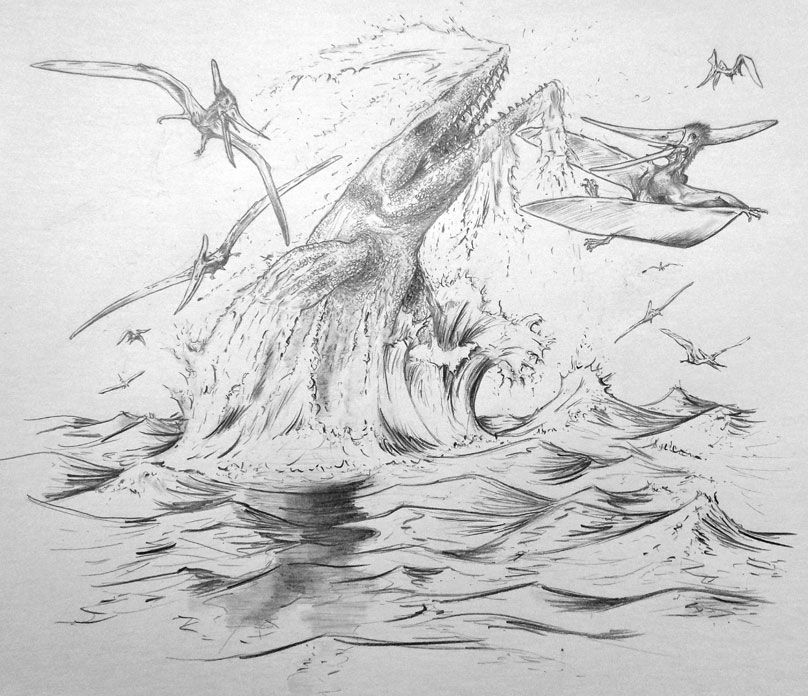
Quand on est un Pteranodon qui pêche en pitchant sous la surface on s'expose au prédateurs qui rodent juste sous les vagues. Un grand Tylosaurus proriger a décidé de mettre un repas plus substantiel à son menu que ses habituelles ammonites, il jaillit en essayant d'attraper un Pteranodon qui faisait du rase motte pour repérer les poissons, mais comme le ptéro est très manoeuvrant il bat des ailes en arrière et le tylo en est pour ses frais.
Regardez son oeil rageur!
Re: Dessins 2013
Posté par Gigy, dans Vos créations,
le
61 184
Merci!

Vaste question, comme on a jamais pu en observer c'est très difficile de dire quelque chose, mais on peut quand même supputer ceci: La plupart de ptéro ont des anatomies pourvues d'artifices spectaculaires (crêtes de toutes sorte), Ce fait est établi et indique que ces animaux pouvaient en disposer pour des parades, mais le faisaient t'ils?
Pour moi je pense que oui pour deux raisons:
La première est que chez Pteranodon on a clairement identifié deux sexes, les mâles aux crêtes hautes et bassins étroits et les femelles aux crêtes basses et aux bassins larges.
Si il y a dimorphisme, c'est pour s'en servir!
En avaient t'il les capacités? Là aussi hypothèse mais confortée par les scan des cavités endocrânennes des ptéro.
La partie dévolue à la cognition est bien développée, ce qui indiquerait la possibilité de pouvoir recourir à des comportements complexes.
Oui pour au moins deux ptéro (oeufs incubés avec des embryons) un ptéro que j'ai dessiné, le Pterodaustro ou flamand rose ptérosaurien et un autre ptéro chinois.
On a aussi un Darwinopterus qui est supposé avoir expulsé un oeuf au moment du dégagement des gaz lors de la décomposition, mais l'oeuf n'était pas incubé. Ces oeufs semblent ovales, parfois très allongés et ils semblent avoir eu une coquille peu minéralisée (effet de l'évolution vers une perte de poids maximum pour continuer à voler durant l'ovogénèse?).
Là encore pas de preuves mais des présomptions. Les embryons trouvés ont les même proportions alaires que les adultes ce qui indiquerait que ceux-ci étaient en mesure de prendre leur envol très vite si pas tout de suite. La minéralisation des articulations est également très avancée et ce même chez des animaux très jeunes. Donc nidifuges? Peut être, de plus les jeunes naissaient avec tout leur équipement dentaire, alors? Est ce que l'image de papa ou de maman amenant la nourriture est fausse, peut être pas, mais les fossiles disent le contraire.

Re: Dessins 2013
Posté par Gigy, dans Vos créations,
le
61 358
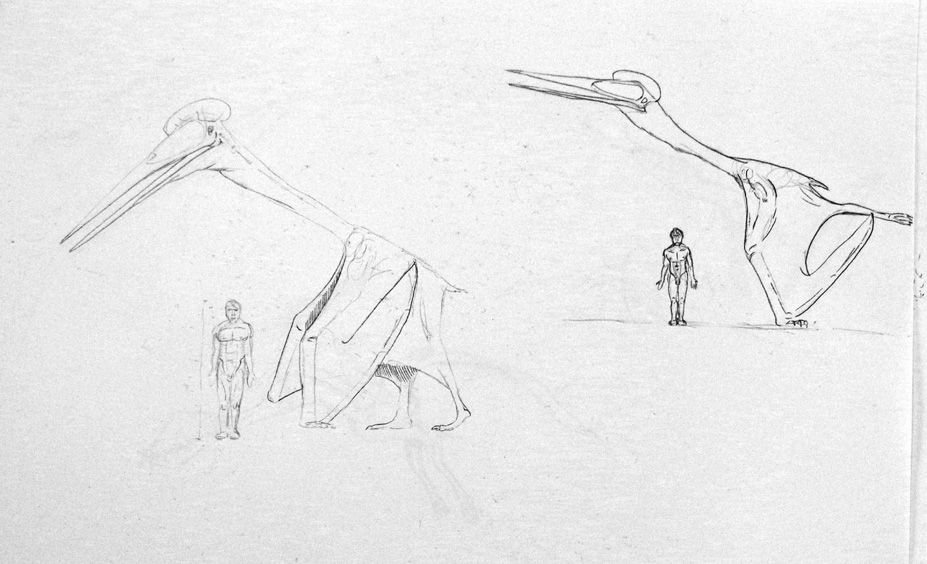
Ah les grands Ahzdarchidae quels morceaux! Ici Hatzegopteryx ou Quetzalcoatlus, avec un spécimen au sol et un autre au décollage toujours selon Habib.
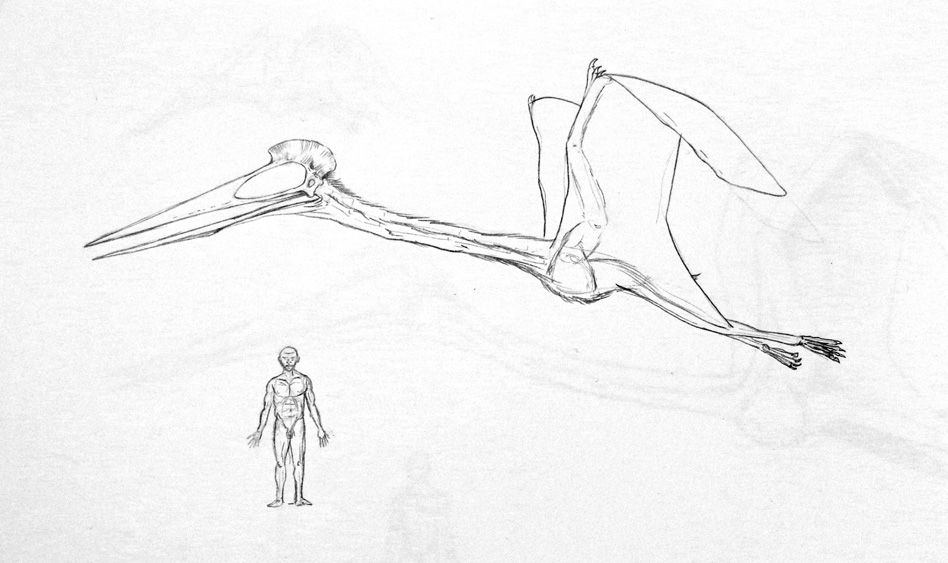
Un petit détail pour mieux se rendre compte des proportions. Crâne 3 mètres! Celui-ci est reconstitué sur base d'un spécimen publié par Kellner-Langston en 1996 et qui était un petit avec un crâne d'un peu plus de 1,50 m. Les proportions de 3 mètres se basent sur des os isolés de Quetz et de Hatzeg de proportions nettement plus grandes.
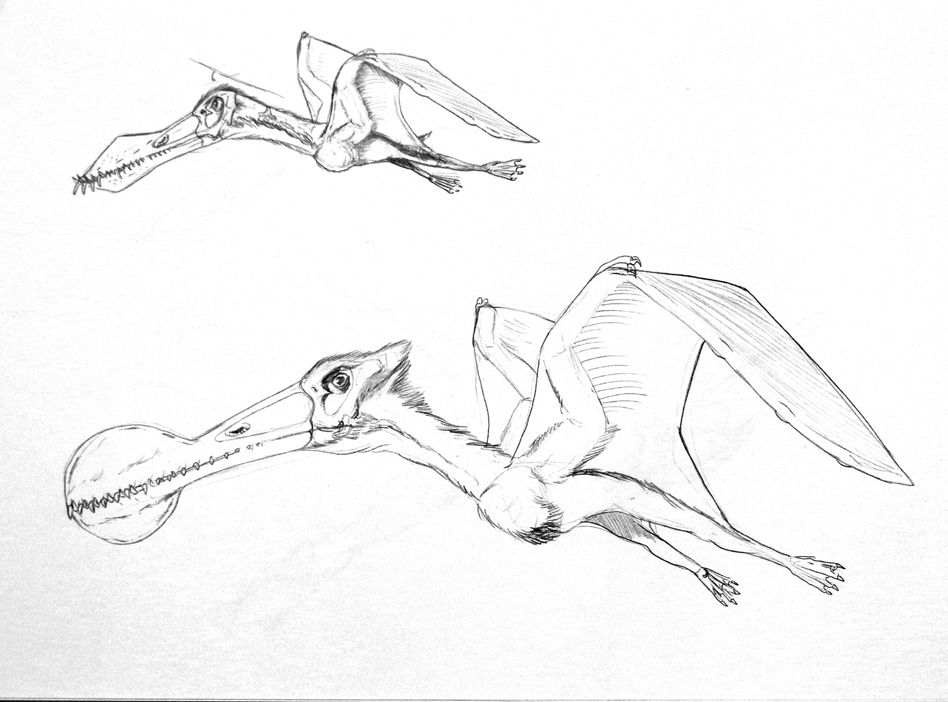
Comparaison entre un Anhanguera au crâne de 60 cm (blittersdorffi) et Tropeognathus (nouveau spécimen est supposé avoir eu un crâne de 90 cm et une envergure de 7 à 8 mètres). On est loin des 12 mètres de la BBC mais c'est quand même énorme et pourtant...
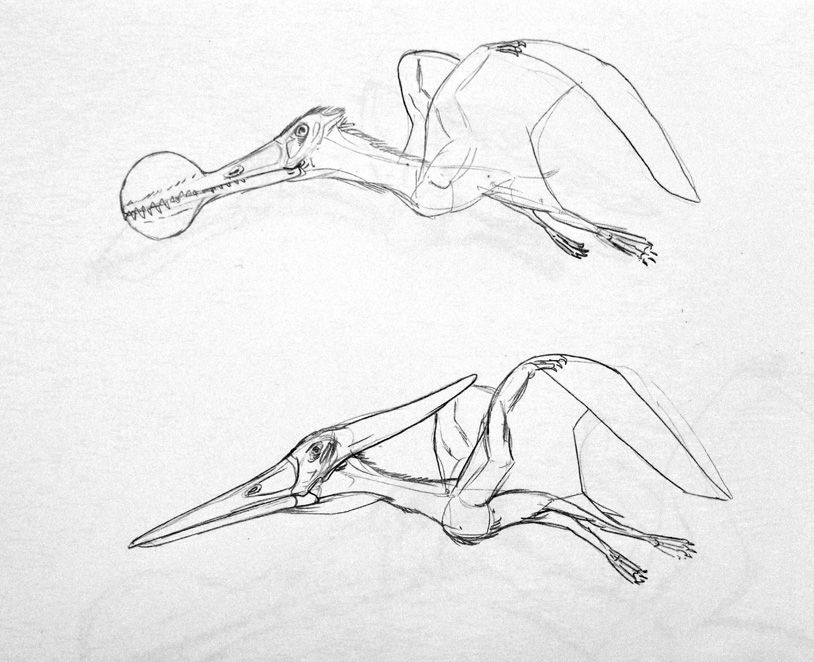
Voici un Pteranodon longiceps avec son crâne de 1,70 m. regardez ses proportions maintenant le voici comparé à...
Hatzegopteryx, gargantuesque, une giraffe volante!
----------
Edité le 27/05/2013 à 23:22 par gigy
Re: Les fiches de dinosaures de Tyranno59
Posté par PoSoPo123, dans Débutants,
le
14 184
Acrocanthosaurus reptile à épines dorsales milieu du crétacé Amérique du nord Carcharodontosauridae Théropodes Oui Tenontosaurus Sauropodes 12
Allosaurus reptile différent Jurassique supérieur Amérique du nord Allosauridae Théropodes Oui Diplodocus Camrasaurus Stegosaurus 12
Carcharodontosaurus lézard à dents de requins crétacé inférieur Afrique du Nord Carcharodontosauridae Théropodes Oui Bahariasaurus Paralititan 14
Tyrannosaurus lézard tyran crétacé supérieur Amérique du nord Tyrannosauridae Théropodes Oui Tricératops ou Charognard 12 à 15
Cristatusaurus lézard à crête crétacé inférieur Niger Spinosauridae Théropodes Oui poissons 10
Giganotosaurus reptile géant du Sud crétacé supérieur Argentine Carcharodontosauridae Théropodes Oui Argentinosaurus 13
Ornitholestes voleur d' oiseaux Jurassique supérieur Amérique du nord Droméosauridae Théropodes Oui oiseaux 2
éoraptor voleur de l'aube Trias supérieur Argentine pas de famille Théropodes Oui insectes 1
Spinosaurus reptile à épines milieu du crétacé Afrique du Nord Spinosauridae Théropodes Oui poissons 15 à 18
Hatzegoptéryx l'aile du hatzeg crétacé supérieur Roumanie Ptérodactiloïdae Ptérosaures Oui poissons,oiseaux 12
Ptéranodon ailé et sans dent crétacé supérieur Amérique du nord Ptérodactiloïdae Ptérosaures Oui poissons,oiseaux 7
Baryonyx lourde griffe crétacé inférieur Angleterre Spinosauridae Théropodes Oui poissons 9
Nanotyrannus petit tyran crétacé supérieur Amérique du nord Tyrannosauridae Théropodes Oui petits hadrosaures 5
Bambiraptor Bambi le voleur crétacé supérieur Montana Dromeosauridae Théropodes Oui petits amphibiens 90cm
Vélociraptor voleur véloce crétacé supérieur Mongolie,Chine Dromeosauridae Théropodes Oui protoceratops 1,80
Gorgosaurus reptile dragon crétacé supérieur Amérique du nord Tyrannosauridae Théropodes Oui Kritosaurus,pentaceratops 7
Albertosaurus reptile de l' alberta crétacé supérieur Amérique du nord Tyrannosauridae Théropodes Oui Corythosaurus,Hypacrosaurus 8
Re: Primeval
Posté par AgressiveHumanParasa, dans Archives des forums,
le
19 899
Re: Primeval
Posté par Fablespinosaurus, dans Archives des forums,
le
17 735
Du Titanoboa à l'Albertosaurus en passant par le Ptéranodon et un Dromaeosauridae, c'est plutôt pas mal comme créatures

Re: Dinostory
Posté par Dino2052, dans Vos créations,
le
21 493


Re: Dinostory
Posté par Stalker, dans Vos créations,
le
21 505
Pour ce coup ci je dirais que c'est pas tout à fait faux. Ce n'est pas un oiseau, mais ce n'est pas non plus un reptile au sens conventionnel: pas d'écailles, sang chaud, picnofibres. Mais sachant que d'un point de vue cladistique "reptile" ne veut plus rien dire...
Re: Dinostory
Posté par AgressiveHumanParasa, dans Vos créations,
le
21 540
ok n'importe quoi
. Ok ce n'est pas un oiseau. Mais si ce n'est pas un reptile c'est quoi alors? Un amphibien peut-être? Pfff...